
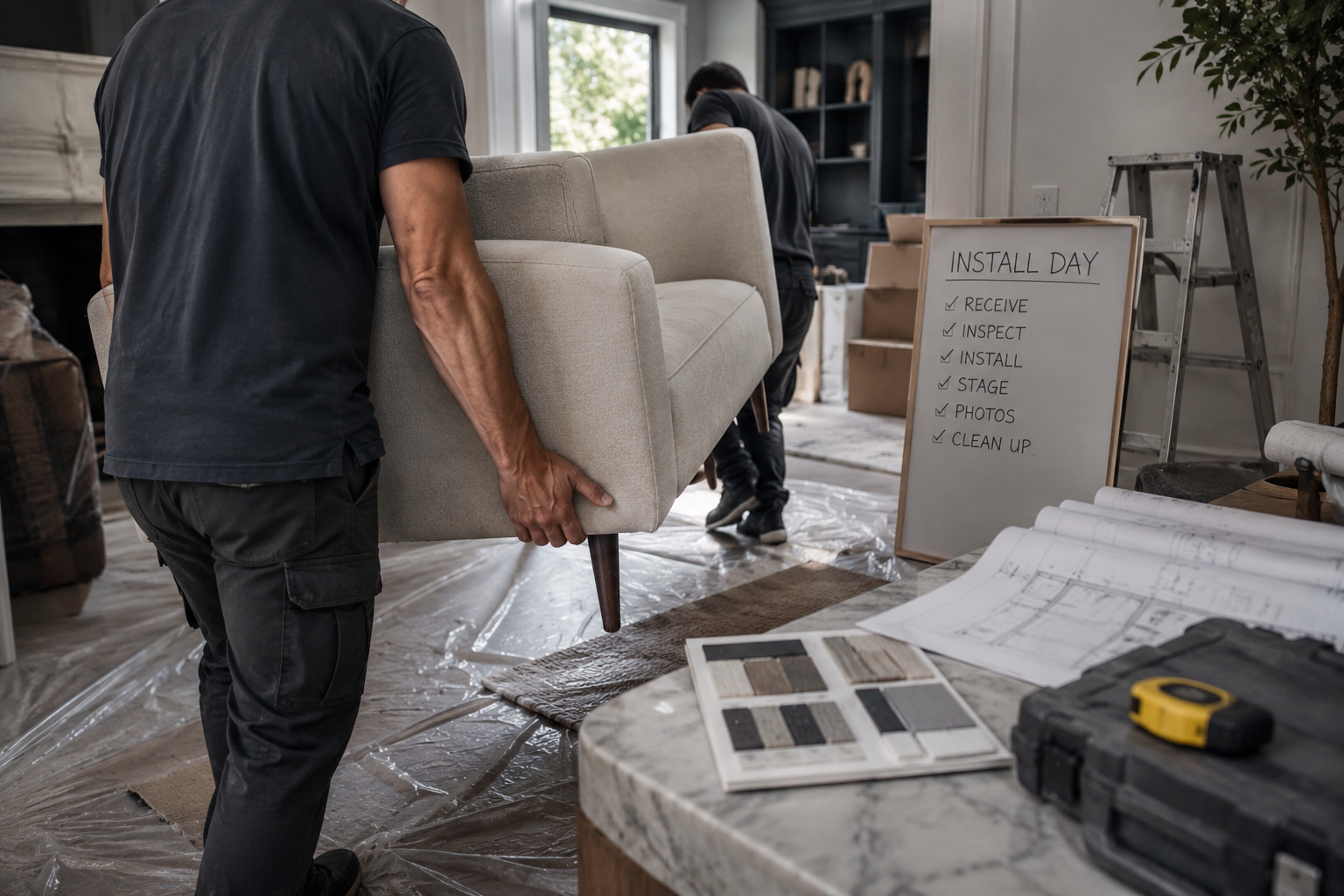
Install day is the moment a design project stops being a mood board and becomes a physical space. It’s the day the most people, the heaviest furniture, and the tightest timelines all converge in one home at once.
It is for precisely this reason that install day is the most liability-prone day in most residential interior design projects.
Table of Contents
ToggleWhy Install Days Carry Disproportionate Risk
Most of an interior design engagement happens in low-risk environments. Client meetings, sourcing trips, renderings, and vendor coordination rarely put anyone in physical danger.
Install day flips that entirely. A design studio’s own team, delivery crews, movers, and sometimes trades like electricians or art installers are all working in the same occupied space at once.
That work often happens against a hard deadline, like a styling shoot or a client move-in date.
Installation day for interior design is high on liability risks due to the concentration of physical work, lifting of heavy furniture, and third parties all at one time in an enclosed area.
A few conditions specific to install day make it different from the rest of a project timeline:
- Large furniture and art pieces move through narrow hallways, stairwells, and doorways, where damage to walls, flooring, or the pieces themselves is common
- Multiple crews (movers, art installers, electricians for lighting) are often on-site simultaneously, raising the odds of miscommunication in a shared work area
- Homeowners or family members are frequently present and moving through the space while work is happening
- Time pressure before a shoot or walkthrough can push a crew to skip small steps, like clearing a path or securing a rug before rolling a heavy item across it.
Occupied homes add another layer of complexity that a vacant construction site doesn’t have. Pets, children, and the homeowner’s daily routine are all still active around the install.
A crew focused on getting a sectional up a staircase may not notice a dog underfoot or a toddler wandering into a stairwell. That split attention is where a lot of install-day incidents actually start.
What General Liability Insurance Covers on Install Day
The particular form of insurance that is relevant to installation day incidents is general liability insurance. It provides protection for third-party injuries and damage caused by the studio’s operations.
For a design studio, that typically means two things: damage to the client’s home, and injury to anyone on-site who isn’t an employee.
Damage might look like a scratched floor, a cracked stair tread, or a dented wall. Injured non-employees could include the homeowner, a delivery driver, or a visiting family member.
A design studio’s general liability insurance should cover property damage to the client’s home and injuries to non-employees that occur during furniture delivery, installation, or styling work.
A few coverage details worth confirming before install day, not after an incident:
- Per-occurrence limit: whether it’s sufficient to cover a serious property damage claim, such as a cracked custom floor or a damaged piece of art
- Coverage for subcontracted crews: whether movers, art installers, or electricians brought in for the day are covered under the studio’s policy or need to carry their own
- Care, custody, and control exclusions: Many insurance contracts provide an exclusion to damage to those properties which are “in care, custody, or control of the insured,” which may create a loophole when there is damage to an item that has been sourced.
That last point is one of the more commonly misunderstood parts of coverage for design studios specifically.
A policy that looks comprehensive on paper can still leave a gap. If it excludes damage to goods actively being handled or installed by the studio’s own team, that’s precisely the scenario that happens most often on install day.
Studios that also manage general contracting work, not just design, face a more layered version of this problem. Contractor general liability insurance typically needs to account for both the construction-side risks and the install-day handling risks under one policy.
Studios that only do design and sourcing, without any construction scope, still need to confirm their policy extends to the physical handling of goods, not just professional advice or design services. A policy written primarily around design consulting can under-cover the hands-on reality of install day. This is one of the most overlooked gaps in interior design studio liability planning, since most policies are purchased with client-facing services in mind rather than physical installation work.
The People-Management Side of Install Day Safety
Insurance addresses what happens after an incident. The bigger lever most studios underuse is reducing how often incidents happen in the first place.
According to OSHA’s Focus Four construction hazards guidance, the common causes of on-site injury in construction and installation are falling, being struck by an object, being caught between objects, and electrical shock.
These types correspond directly to a normal day during a design installation, which requires ladders, large furniture, and lighting.
Practical steps that reduce risk without slowing down the timeline:
- Clear and mark walking paths before movers arrive, rather than routing them through a space still full of packing materials
- Stage heavy or awkward items in a single designated area instead of scattering them throughout the home
- Confirm who is responsible for each trade’s safety on-site when multiple crews overlap, so no one assumes someone else is managing it.
- Walk the space with the client beforehand to flag anything fragile or irreplaceable.
Little things like this will make a huge difference even on your most hectic installation day. A clear walkway takes only two minutes to set up but could prevent an injury that lasts weeks.
The same coordination challenges scale up on larger projects. Anyone who has worked alongside a commercial construction team on a hospitality or retail buildout knows that multi-crew coordination only gets harder as the number of trades on-site increases.
Contract Language That Protects Both the Studio and the Client
On-site insurance and safety practices become most important when the contract language sets expectations prior to installation day.
The design contract should stipulate responsibility for photographing pre-existing damage, covering any cost involved with a damaged sourced item, and dealing with delays that result in overtime install hours.
Clear contract language addressing damage responsibility, subcontractor coverage, and pre-existing condition documentation reduces disputes when an install-day incident occurs.
A very good practice of photographing the room prior to beginning the installation process helps settle numerous disputes.
A time-stamped set of photos showing the pre-install condition of floors, walls, and existing furniture removes the ambiguity that often turns a minor scuff into a drawn-out disagreement.
The same instinct applies to protecting finished surfaces during any messy phase of a project. It’s the kind of thinking behind a family-friendly approach to keeping high-traffic spaces protected while work is underway.
A short walkthrough with the client before crews arrive costs almost nothing in time. It can save days of back-and-forth if a dispute comes up later.
Conclusion
Install day is where a design studio’s insurance, planning, and on-site management all get tested at once.
A studio that has verified adequate general liability coverage, confirmed how subcontracted crews are insured, and built basic safety habits into the install process turns the riskiest day of the project into a well-managed one instead of an exposed one.
This is beneficial for the clients too. A properly documented, covered, and well-organized installation day can save their carefully planned house.
FAQ
Does a design studio’s general liability policy cover damage to items it sourced for the client?
It depends on the policy’s care, custody, and control provisions. Many general liability policies exclude damage to property the business is actively handling, so this is worth confirming separately.
Who is liable if a delivery crew damages a client’s home during install?
Liability can be determined by which party gave directions and whose insurance covered the crew. In cases where the moving crew was hired and directed by the design studio, liability falls to their general liability insurance.
Should a design studio require its subcontractors to carry their own insurance?
Yes. Requesting a certificate of insurance from any subcontracted crew, movers, art installers, or electricians is a standard way to confirm coverage exists independently of the studio’s own policy.
What’s the easiest way to prevent disputes over pre-existing damage?
Photographing the space in detail before work begins creates a time-stamped record. It resolves most disagreements about what damage existed before the install versus what happened during it.
Does it matter if the studio only handles design and sourcing, not construction?
Yes. A policy built around design consulting doesn’t automatically cover the physical handling of furniture and goods. Studios without construction scope still need coverage that accounts for hands-on install work.